GOVERNMENT SCHEMES FOR WEAVERS

Ministry of Textiles is implementing various schemes for welfare of weavers and development of handloom sector across the country. The schemes are Handloom Weavers’ Comprehensive Welfare Scheme (HWCWS), National Handloom Development Programme (NHDP), Yarn Supply Scheme (YSS) and Comprehensive Handloom Cluster Development Scheme (CHCDS) for eight mega handloom clusters in the country.

Under these schemes, financial assistance is provided for raw materials, purchase of looms and accessories, design innovation, product diversification, infrastructure development, skill upgradation, marketing of handloom products and loan at concessional rates. Besides, the Government of India has reserved 11 textiles articles, including sarees with technical specifications for exclusive production by handlooms under The Handlooms (Reservation of Articles for production) Act, 1985. Balaramapuram sarees from Kerala has also been registered under Geographical Indications Act. Five block level clusters, including Kollayil Cluster, Thiruvananthapuram district, have been sanctioned with a total project cost of Rs. 8.86 crore with Government of India share of Rs. 8.63 crore and released Rs. 2.77 crore as first instalment.

In order to address the health related issues of handloom weavers of the country, including weavers of Balaramapuram, Ministry of Textiles has been implementing Handloom Weavers’ Comprehensive Welfare Scheme. Life insurance cover to handloom weavers and workers in the age group of 18-50 year is provided under Pradhan Mantri Jivan Jyoti Bima Yojana (PMJJBY) and accidental insurance cover to handloom weavers and workers in the age group of 18-50 years is provided under Pradhan Mantri Suraksha Bima Yojana(PMSBY). Closed group of handloom weavers in the age group of 51-59 years, which are already enrolled as on 31.05.2017 under the Mahatma Gandhi Bunkar Bima Yojana (MGBBY) will continue to get cover under the converged MGBBY. The benefits of schemes are available to all the handloom weavers, including widowed weavers. Also, scholarship of Rs. 1200 per year per child upto 2 children is also provided to the handloom weavers.

Credit requirements of handloom weavers are met under Weavers’ MUDRA scheme, a component of NHDP. Under the scheme, credit is provided at concessional interest rate of 6% to the handloom weavers with margin money assistance upto Rs. 10,000 per weaver and credit guarantee for a period of 3 years. In Kerala, 324 weavers have been sanctioned Mudra loan worth Rs. 1.61 crore in last three years.

In order to attract younger generation into the handloom profession, provision has been made under NHDP for skill upgradation. An MoU has been signed with NIFT, New Delhi to promote handlooms through fashion by introducing handlooms in the course curriculum of Under-Graduate and Post-Graduate courses from academic session 2016-17.
HANDLOOM VS POWERLOOM

Meaning of Handloom and Power loom

The handloom is a manually operated loom used to weave cloth without the aid of electric power. This is a woven fabric that uses mechanical energy of the weaver and the motion of the handloom is purely manually operated instead of use of electric energy.

Loom is actually a device used to weave patterns on fabric and the process is called weaving. Power looms, on the other hand, are fundamentally different from handlooms and are powered mechanically rather than using human power to weave patterns into cloth.

Handloom

A handloom is a type of loom used to weave cloth or patterns on cloth and is operated manually without the aid of electric power. What started as a mechanism to furnish necessities has become a specialized tool for the handicraftsman specializes in furnishing art and luxury fabrics.

The growing textile industry has created a vast demand for the handloom weavers which shaped the much of the 19th century cotton industry. No one exactly knows how or when weaving began, but the idea of weaving clearly predates the loom by at least thousands of years. However, the once commodity-generating sector is dying owing to the rise of more efficient modern looms such as power looms.

Power loom

A power loom is a type of mechanically powered loom driven by a steam engine or electric power used to weave cloth. It was not until the 1850’s that the power loom industry really came into the picture, owing to the rising demand of cotton and scarcity of production.

Power looms are a major shift from the conventional handlooms that once dominated the textile industry. As they are mechanically powered, they work at least ten times faster than their handloom counterparts, thereby controlling much of the fabric market. However, a power loom can only replicate a limited variety of designs and patterns.

Difference between Handloom and Power loom

Both are tools used to weave patterns of thread into cloth for making woven fabric such as cotton, but this is where the similarities end. This article highlights some key points comparing the two weaving tools.

  • Operation of Handloom and power loom

A loom is simply a device used to weave cloth and tapestry and operated wholly or partly by human hands. Manually operated weaving is done on pit looms or frame looms. A pit loom, as the name suggests, is a type of loom set on the floor facing a pit so that yarn can get moisture and two peddles set for the weaver to operate. A frame loom is a self-supported loom that sits above the floor with almost similar mechanism to what the ground looms hold and are mainly used to produce twill, sating fabric. However, both looms can be used to weave malkha cloth.

  • Efficiency of Handloom Vs. power loom

A power loom is mechanized loom which runs by steam or electric power. The looms are driven by a steam engine by belts which lead to more effective and efficient output, plus higher quality of fabric produced compared to handlooms. The handlooms, on the other hand, are used to weave fabric using hand and loom made from wood and the resultant yarn varies according to the materials used and the skill of the weaver, which may result in a less effective fabric. The handloom is the oldest type of loom used for weaving, thus cannot produce complex designs like power looms.

  • Features in Handloom Vs. Power loom

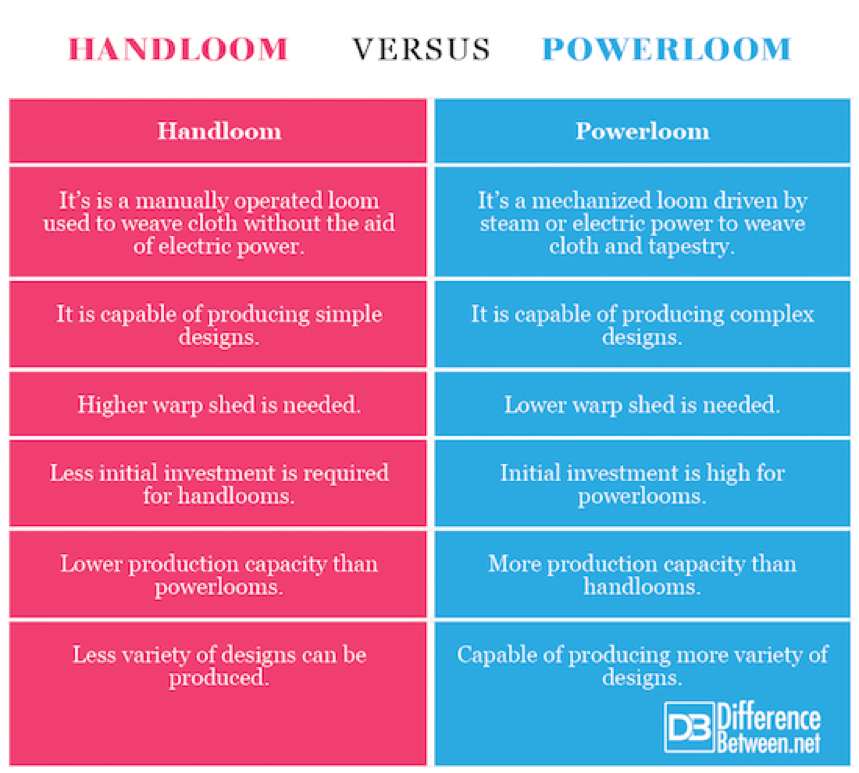
Both handlooms and power looms use a small carrier device called shuttle for yarn insertion, except warp threads are raised and lowered by manual shedding in handlooms which requires higher warp shed, which accounts for high-quality woven fabric. Power looms are modern looms with higher production capacity than handlooms, plus they are able to produce complex designs with less or no human effort. Although, initial investment is high in power looms, they operate at much higher speeds than their handloom counterparts which results in the production of more variety of designs.

Handloom vs. Power loom: Comparison Chart

http://cdn.differencebetween.net/wp-content/uploads/2018/06/Handloom-VERSUS-Powerloom.jpg

Summary of Handloom Verses power loom

Although both handlooms and power looms are tools used for weaving patterns or thread into cloth, they are fundamentally different in the way they operate. Handlooms are manually operated looms used for weaving in which picking and beating is done manually by human hands, whereas power looms are mechanised looms driven by stem engines or electric power in which shedding, picking and beating are done automatically rather than manually. The features alone indicate the main advantages of the more efficient power looms over the conventional manually operated handlooms. Handloom industry is dying slowly owing to the rise of more efficient and effective power looms which are capable of producing effective designs at much higher speeds.

Yemmiganur, Kurnool, Andhra Pradesh, India

Yemmiganur, formerly Emmiganur, is a town in Kurnool district, of Andhra Pradesh state, southern India. It lies in the upland Rayalaseema region, about 16 km south of the Tungabhadra River.  Some of the villages that surround Yemmiganur are Gudikal, Kandanathi, kadivella, kadimetla, Banavasi, Devibetta, Parlapalle, and Kotekal.

Yemmiganur was included in the hindu kingdom of Vijaynagar, which flourished during 14th to 16th century. Later the town came under the Muslim rule. Yemmiganur’s popular industries are cotton ginning, peanut milling, and weaving. Yemmiganur was upgraded to 1st Grade Municipality in the year 1999. In this Municipality weaving is the main occupation. The population of the town is 169,344 as per the census of 2011.

Geography

The geo-coordinates of Ymmiganur is 15.7642° N, 77.4759° E. The area covered is 14.5km2  and the maximum elevation is 378m. Hyderabad is the state capital for Yemmiganur which is also the capital of Andhra Pradesh. Other nearest state capitals are Bangalore 306.2 KM., Chennai 421.5 KM, Pondicherry 491.9 KM.

History of Yemmiganur

Yemmiganur is one of the major towns in the Kurnool district. It was part of the Vijayanagar from the 14th century to the 16th century. From 1953 to 1956 it was an Andhra state, now in part of Andhra Pradesh. In 1965 the Panchayat of Yemiganur was upgraded as 3rd grade Municipality upgraded as 2nd grade Municipality during 1985 and upgraded 1st Grade Municipality during 1999. Soils are of the Black Cotton nature and hence are highly potential for commercial crops like Groundnut and Cotton. Being surrounded by Irrigation Canal i.e. low level canal drawn from Tungabhadra Dam at Hospet in Karnataka State.

Yemmiganur Municipality is known for its Handlooms. It is located 375 Kms from Capital City and 70 Kms from District Head Quarters.

Demographics of Yemmiganur

According to the census conducted in 2011, the town had a population of 169,344. The total population constitutes 84,334 males, females and 85,011 and 15.4% of the population is under the age of 6. Based on population, Yemmiganur is ranked 5th in Kurnool district and ranked 70th in Andhra Pradesh

Yemmiganur has total 84,289 people employed. Out of total employed people,47,369 are male and 36,920 are female. The average literacy rate stands at 54% with 78,289literates, significantly lower than the national average of 73.00%. In terms of literacy, Yemmiganur ranks at 40th in Kurnool district and ranked 954th in Andhra Pradesh.

  Rural Urban
Household 42.5% 57.5%
Total population 71,972 97,372
Male population 35,411 48,492
Female population 36,129 48,880
Kids under 6 years 11,084 14,995
Girls under 6 years 5,432 7,348
Boys under 6 years 5,652 7,647
Total literates 38,865 52,580
Total illiterates 32,387 43,818

Education

The primary and secondary school education is imparted by government aided and private schools, under the School Education Department of the state. The medium of instruction followed by different schools are English, and Telugu.

Economy

Yemmiganur is one of the important Commercial Centres in Kurnool District. Being surrounded by number of villages whose activity is Agriculture. Mainly commercial crops like Groundnut, Cotton in addition to Paddy are grown in this area Irrigation Canal drawn from Tunga – Bhadra Project known as LLC Canal flows around Yemmiganur irrigating vast extent of land. Hence there is busy commercial activity for the agricultural produce resulting establishment of huge big Agricultural Market Yard as well Handlooms Textiles.

Villages that lie under Yemmiganur

There re total 18 villages that fall under the Yemmiganur administration. The villages are mentioned below with the population they have.

Banavasi – 4,695 Kadivella – 5,248
Devibetta – 1,652 Kalugotla – 4,551
Divamdinne – 4,571 Kandanathi – 7,659
Enigabala – 2,574 Kotekal – 6,115
Garladinne – 814 Malakapuram – 1,973
Gudikal – 11,213 Parlapalle – 4,648
K. Thimmapuram – 2,939 Pesaladinne – 1,268
Kadimetla – 8,919 Ralladoddi – 1,253
Soganur – 2,227 Tsallakudlur – 1,876

For more information, stay tuned.!